
Seed to Stalk: What It’s Actually Like to grow Industrial Hemp

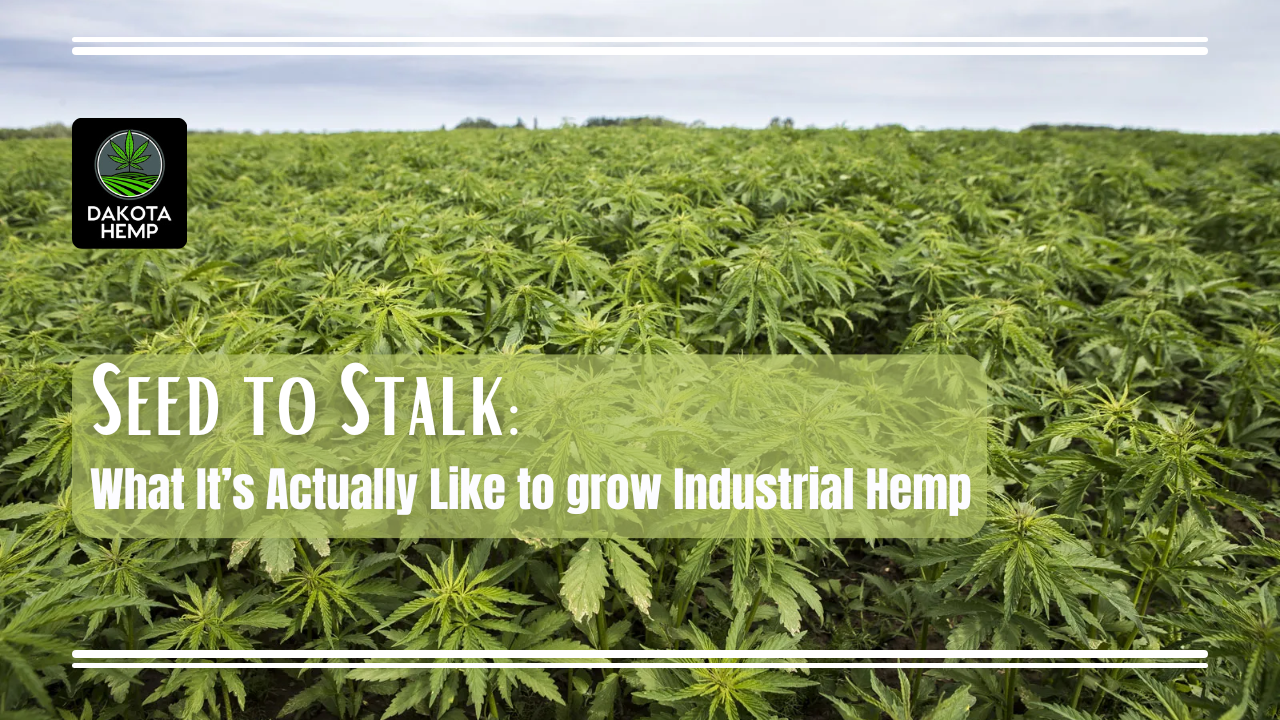
If you’ve ever driven past a field of industrial hemp in the peak of a South Dakota summer, you know the sight is something special. It’s not like a cornfield, where you can see the rows stretching out in neat, organized lines. A hemp field is a literal wall of green—a dense, vibrating forest of leaves that can tower ten or twelve feet over your head. It’s a sight that stops people in their tracks, but for those of us standing at the edge of the fence, the question is always the same: How on earth do you get it that way?
Growing hemp isn’t like growing any other row crop in the Midwest. It has its own rhythm, its own set of stubborn rules, and a personality that requires a bit of a learning curve. As we look toward the 2026 season, let’s pull back the curtain on what it actually looks like to take a crop of industrial hemp from a tiny seed in a bag to a massive, industrial-grade bale.
1. The Quiet Beginning: Finding the Right Bed
Every farmer knows that a crop is only as good as the soil it starts in. Hemp isn’t exactly a “diva,” but it doesn’t like to be ignored. It thrives in well-drained, loamy soil—the kind of dirt that feels rich, holds onto its nutrients, and crumbles just right in your hand.
The biggest thing to remember? Hemp hates “wet feet.” If the ground stays soggy, the roots won’t take, and the plant will just sit there pouting.
In terms of climate, hemp is a sun-seeker. It loves long days and warm temperatures, but it’s surprisingly hardy once it gets going. Here in the heartland, we wait until the soil hits a steady $50^\circ\text{F}$ before we even think about pulling the seeder out of the shed. We plant it close together—much closer than corn—because we want the plants to grow up, not out. This creates those long, beautiful stalks that are packed with the fiber we’re after.
2. The Great Summer Sprint
Once those seeds hit the ground (usually just about an inch deep), the race is on. If you get a good rain and the sun stays out, you’ll see sprouts poking through the dirt in as little as three days.
This is where the “magic” happens. For the first few weeks, the plant is quiet, focusing all its energy on driving a deep taproot into the subsoil. But once that anchor is set, the vegetative stage begins, and the growth rate is honestly a little bit intimidating.
- The “Foot-a-Week” Rule: During a hot July, a healthy hemp plant can grow more than a foot in a single week. You can almost hear it growing.
- The Natural Filter: Because we plant it so densely, the hemp quickly creates a thick canopy. By the time it’s waist-high, no sunlight can reach the ground. This means any weeds trying to compete are simply starved of light. It’s nature’s way of keeping the field clean without us having to reach for a jug of herbicide.
3. The Harvest Dance: Timing and the “Retting” Secret
When we grow hemp for fiber and hurd, we aren’t waiting for a flower or a seed head to mature. We’re watching the stalks. We want them to reach their peak height and “woodiness” before the plant starts putting its energy into reproduction. Usually, this happens about 90 to 120 days after the first sprout appears.
But here is where hemp gets unique: we don’t just cut it and haul it away.
First, we use a specialized mower to lay the stalks down in neat rows (called windrows). Then, we let them sit there. This is a process called “field retting,” and it’s the most nerve-wracking and beautiful part of the whole cycle.
For two to five weeks, the dew, rain, and sunshine work together. Natural microbes in the environment start to break down the “lignin”—the natural glue that holds the tough outer fibers to the woody inner core.
- The Balance: If we pick it up too soon, the fiber won’t separate. If we wait too long, the weather can start to weaken the strands. It takes a keen eye and a bit of luck with the weather forecast to know exactly when to pull the trigger.
4. Bringing It Home: The Baling Challenge
Once the stalks have rotted and dried down to about 15% moisture, it’s time to bale. We use standard large square or round balers, but let me tell you—hemp is a workout for any machine. These fibers are legendary for their strength, which is great for the final product but can be a headache for bearings and belts.
These bales are then loaded up and sent to our facility for decortication. This is the high-tech part of the journey where we finally pull the plant apart, separating the bast fiber for textiles and the hurd for things like Animal Bedding.
Real Talk: The Questions We Get at the Fence Post
Is it hard on your equipment?
I won’t lie to you—hemp is tough. If you don’t know what you’re doing, those long fibers can wrap around a spindle faster than you can yell “stop.” But as the industry has grown into 2026, we’ve developed “hemp-proof” kits and better headers that make the job much smoother. It’s all about having the right tool for the job.
Does it really help the soil?
Absolutely. Hemp is a “giver.” Because we leave the leaves and the roots in the field, hemp returns about 60% of its nutrients back to the earth. Most farmers see a significant “yield bump” in the corn or wheat they plant the following year because the hemp left the soil so aerated and clean.
What if it rains during the retting process?
A little rain is actually our friend! It helps those microbes do their job. We just need a good, dry three-day window at the very end so we don’t bale it wet. Baling wet hemp is a recipe for mold, and that’s the one thing we want to avoid.
Conclusion: A Journey Worth Taking
At the end of the day, growing industrial hemp is more than just another commodity in the bin. It’s a return to a style of farming that requires you to be in tune with the land. It’s a crop that challenges you, but it also rewards you with a product that is changing the world—one bale at a time.
Seeing that wall of green in August and knowing that it’s cleaning the air, healing the soil, and turning into something as useful as a house or a shirt… well, that makes all the long days in the field worth it.