Counting the Harvest: How Much Can You Make Per Acre of Hemp?

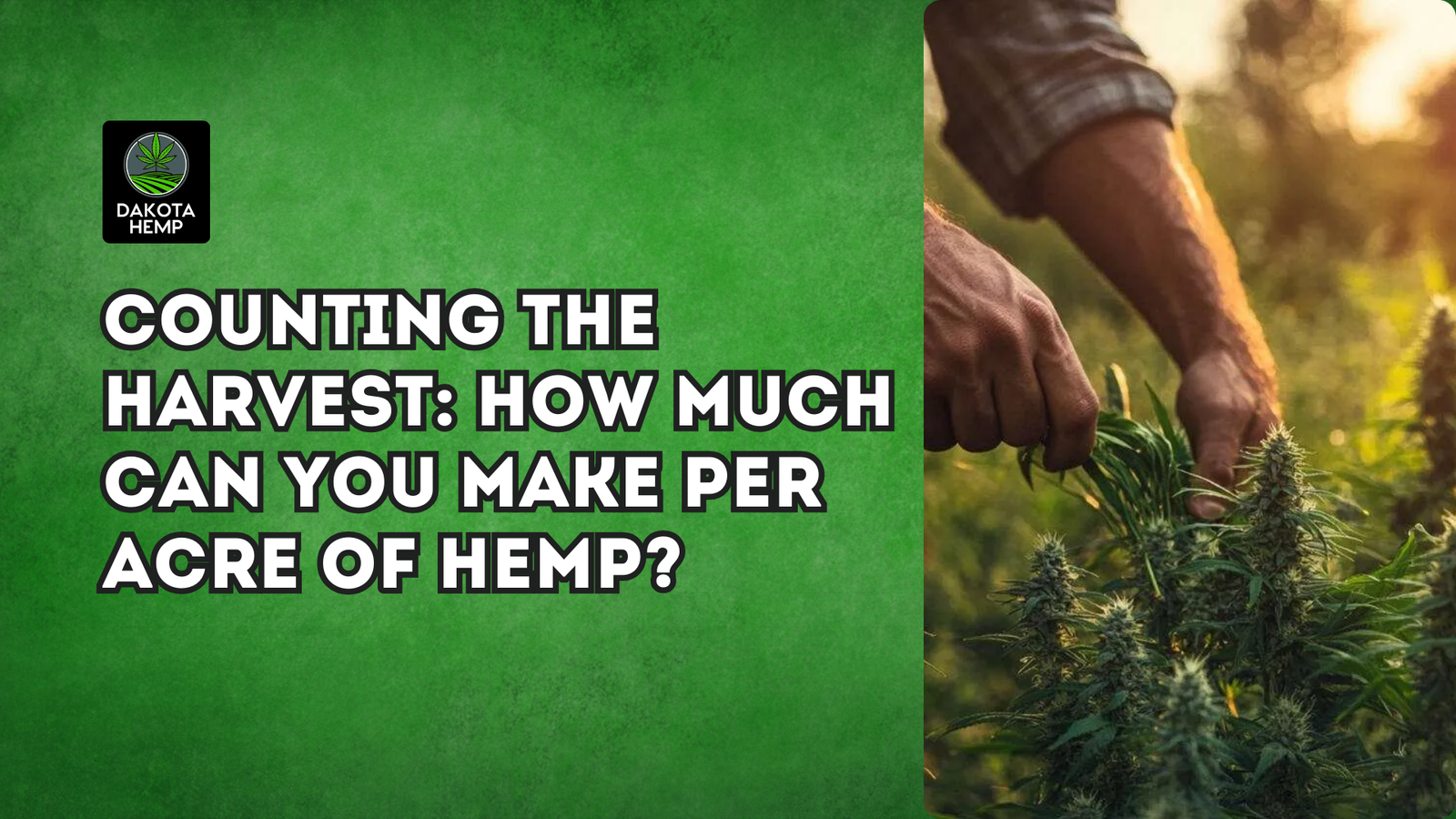
As we move through the 2026 growing season, the agricultural landscape is shifting. After years of market volatility following the 2018 Farm Bill, hemp has finally matured into a sophisticated industrial crop. For farmers in the Great Plains, the question has evolved from “can we grow it?” to “how can we maximize the profit on every acre?”
At Dakota Hemp, we believe that the most successful farmers are the most informed. If you are looking to diversify your acreage this year, here is the full economic breakdown of what you can expect to make per acre of hemp in the current market.
The Three Main Paths to Profit in 2026
The profitability of hemp is not a singular number; it is a spectrum based on your harvest goals. In 2026, the market has bifurcated into three distinct categories: Floral, Fiber, and Grain.
1. Floral Hemp (CBD, CBG, & Specialty Cannabinoids)
Floral hemp remains the highest-margin category, though it is the most capital-intensive. This involves growing “bushy” female plants specifically for their resinous flowers.
- Gross Revenue: $15,000 – $35,000 per acre
- Net Profit Potential: $5,000 – $12,000 per acre
- The Reality: While the numbers look staggering, the input costs are high. You are looking at expensive feminized seeds or transplants and significant labor for harvesting and drying. However, for a farm with the right infrastructure, floral hemp is the “high-value” crown jewel of hemp agriculture.
2. Industrial Fiber (The Construction & Textile Boom)
Fiber is the “workhorse” of the 2026 market. With the rise of sustainable building materials like hempcrete and bioplastics, the demand for stable fiber supplies has skyrocketed.
- Gross Revenue: $800 – $1,600 per acre
- Net Profit Potential: $250 – $550 per acre
- The Reality: While the per-acre profit is lower than floral, the “barrier to entry” is almost non-existent for traditional row-crop farmers. You plant it like wheat, harvest it with modified equipment, and require very little hands-on labor. At Dakota Hemp, we see fiber as the ultimate “volume play” for large-scale operations.
3. Grain and Seed (The Health Food Market)
Hemp grain is currently thriving in the plant-based protein sector. Organic-certified hemp grain is particularly lucrative in 2026.
- Gross Revenue: $750 – $1,200 per acre
- Net Profit Potential: $200 – $450 per acre
- The Reality: This is often grown as a “dual-purpose” crop. Farmers harvest the grain from the top and the fiber from the stalk, effectively creating two checks from one single acre of industrial hemp.
The “Hemp Bump”: Hidden Secondary Revenue
Beyond the harvest check, hemp offers “hidden” financial benefits that are often excluded from standard balance sheets.
1. Yield Increases in Rotation
Data from the 2025-2026 seasons shows that farmers who rotate hemp with corn or soybeans see a 10-15% yield increase in their subsequent crops. Hemp’s deep taproot breaks up “hardpan” soil and cycles nutrients that traditional crops can’t reach. This “Hemp Bump” can add an additional $50–$100 of value to every acre in your rotation.
2. Carbon Credit Revenue
In 2026, carbon sequestration is a real commodity. Because hemp is a “carbon sink”—absorbing more CO2 per acre than a forest of the same size—farmers are now eligible for carbon credits. Depending on the program, this can add a secondary revenue stream of $30–$60 per acre just for the air the plants breathe.
3. Reduced Input Costs
Hemp is naturally resistant to many pests and grows so densely that it “chokes out” weeds. For many Dakota Hemp growers, this translates to a 60-80% reduction in herbicide and pesticide costs compared to conventional soy or corn.
Cost vs. Revenue Comparison (Per Acre)
| Crop Type | Seed/Input Cost | Labor/Processing | Est. Net Profit |
| Floral (CBD/CBG) | $4,000 – $8,000 | High (Hand harvest) | $8,000 – $12,000 |
| Industrial Fiber | $600 – $900 | Low (Mechanical) | $300 – $500 |
| Grain (Organic) | $800 – $1,200 | Medium | $400 – $600 |
Frequently Asked Questions (FAQ)
Q: Is hemp more profitable than corn or soy in 2026?
A: Often, yes. While corn and soy markets fluctuate, the demand for sustainable farming materials and CBD remains steady. When you factor in the reduced chemical costs and the “Hemp Bump” yield increase for the following year, hemp frequently outperforms traditional grains on a “net-net” basis.
Q: What is the biggest risk to my profit?
A: Market access. You should never plant a single seed without a “contract for purchase” or a relationship with a processor like Dakota Hemp. The biggest losses in the industry happen when farmers grow a beautiful crop but have nowhere to take it for processing.
Q: Do I need to buy a new combine for fiber?
A: Not necessarily. Many industrial fiber varieties can be harvested with a standard sickle bar cutter and balers. For grain, most standard combines can be modified with “hemp kits” to prevent the fibrous stalks from wrapping around the moving parts.
Q: How does Dakota Hemp help with profitability?
A: We focus on “Seed-to-product” efficiency. By sourcing high-germination seeds and localized processing in the Great Plains, we help farmers reduce their logistics costs, which is often the biggest “profit killer” in the industry.
Q: Can I make money on “dual-purpose” crops?
A: Yes. In fact, for most Midwest farmers, this is the safest path. Harvesting grain for the food market and the leftover stalks for the fiber market allows you to hedge your bets against price fluctuations in either sector.
The Bottom Line: Efficiency is the New Yield
In the early days of hemp, everyone was looking for a “home run” with CBD. In 2026, the most profitable farmers are the ones playing for “singles and doubles.” By focusing on low-input fiber, organic grain, and the regenerative benefits to the soil, you can build a stable, multi-generational revenue stream.
At Dakota Hemp, we aren’t just selling hurd and fiber; we are helping rebuild the American farm. If you’re ready to see how the math of how hemp works for your specific acreage, let’s start a conversation.