The Economic Advantage: Why Farmers Are Turning to Hemp in 2026

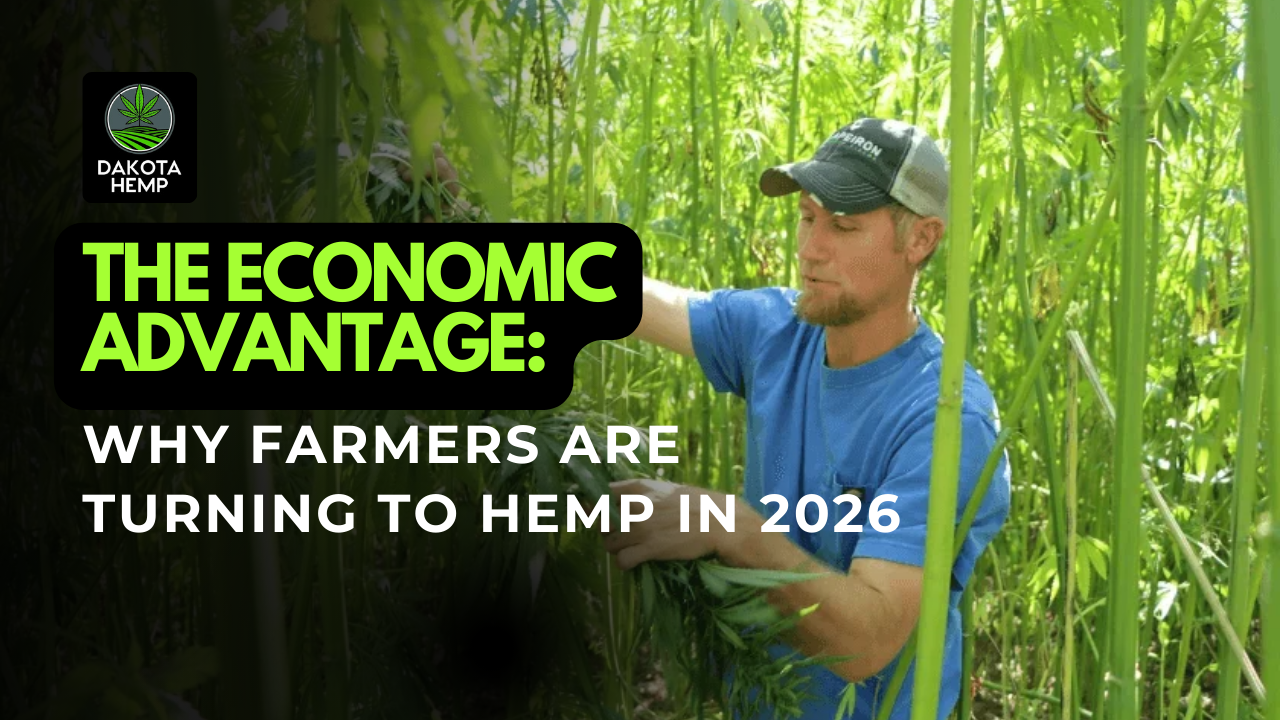
For a long time, the conversation around industrial hemp was mostly about the “planet.” We talked about soil health, carbon sequestration, and saving the bees. And while those things are incredibly important, any family who has farmed for more than a generation knows the cold, hard truth: If it doesn’t make “cents,” it can’t make sense. A farm is a business, not a hobby. As we navigate the economic landscape of 2026—with its fluctuating commodity prices and rising input costs—farmers are looking for more than just a “green” alternative. They are looking for a competitive edge.
At Dakota Hemp, we’ve seen the shift firsthand. The “hemp curiosity” of five years ago has turned into a calculated business move. Here is the breakdown of why industrial hemp is becoming one of the most economically sound decisions a modern producer can make.
1. Slashing the “Input” Bill
In 2026, the price of synthetic fertilizers and specialized chemicals can feel like a weight around a farmer’s neck. Most traditional row crops require a heavy “diet” of nitrogen and a constant defense of herbicides to produce a profitable yield.
Hemp changes the math.
- Natural Weed Control: Because hemp grows so densely and so fast, it “shades out” weeds. For many of our growers, this has meant cutting their herbicide budget by 60% to 80% on those acres.
- Efficient Nutrient Use: While hemp still needs nitrogen, it is far more efficient at using what’s already in the soil. Furthermore, because the leaves and roots stay in the field, it recycles a huge portion of those nutrients back into the ground for next year’s crop.
- The Bottom Line: When you lower your “cost per acre” to grow the crop, your margin for profit gets a whole lot wider.
2. The “Rotation Bump”: Increasing Yields Across the Farm
The economic value of hemp isn’t just found in the hemp harvest itself—it shows up in the following year’s corn or wheat check.
Hemp is a phenomenal “break crop.” It disrupts the life cycles of pests and diseases that usually plague soy and corn. More importantly, its deep taproot system breaks up compacted soil “hardpan” that traditional equipment can’t reach.
- The Data: Growers are reporting a 10–15% yield increase in the crops planted in the year following a hemp rotation.
- The Profit: That extra five or ten bushels of corn per acre is “free” money, courtesy of the soil prep work the hemp did the year before.
3. Diversification: Breaking the Commodity Trap
We’ve all seen what happens when the global market for corn or soy takes a dip. When you’re locked into a single commodity, you’re at the mercy of global forces you can’t control.
Hemp offers a non-correlated market. The demand for hemp fiber in the automotive and textile industries, and for hemp hurd in the construction and animal bedding sectors, doesn’t always follow the same ups and downs as the food and fuel markets.
- Multiple Revenue Streams: With hemp, you aren’t just selling a grain. You’re potentially selling the fiber, the hurd, and even carbon credits. In 2026, being able to sell “Net Zero” credits for the carbon your hemp sequestered is a brand-new, high-margin revenue stream that didn’t exist a decade ago.
4. No Waste, Only Opportunity
In traditional agriculture, “waste” (like corn stover or wheat straw) is often a liability or a low-value byproduct. In the hemp world, we have a “nose-to-tail” philosophy.
At our decortication facility, we ensure that every pound of stalk a farmer brings us has a home.
- The Bast Fiber: Sells into the high-value textile and bioplastic markets.
- The Hurd: Sells into the rapidly growing Animal Bedding market. When every part of the plant has a market value, the “risk” of a total crop loss is significantly mitigated.
Real Talk: The Economic FAQs
“Is the infrastructure actually there to buy my crop?” This was the big question in 2020, but in 2026, the answer is a firm yes. Facilities like Dakota Hemp have created a stable “off-take” point for farmers. We provide the contracts and the processing power to ensure that when you grow it, you have a place to sell it.
“What about the specialized equipment costs?” While there is an upfront investment for specialized headers or mowers, many farmers are finding that the “ROI” (Return on Investment) is reached within 2-3 seasons, especially when you factor in the chemical savings and the rotation bumps.
“Is hemp still considered ‘risky’ by banks?” The landscape has changed. Since the total federal legalization and the stabilization of the 2026 grain and fiber markets, ag-lenders are much more comfortable with hemp as part of a diversified farm plan. It’s no longer viewed as an experiment; it’s viewed as a specialty industrial crop.
Conclusion: Investing in the Future of Your Farm
At the end of the day, switching to industrial hemp farming is about future-proofing your business. It’s about building a farm that is more resilient to drought, less dependent on expensive chemicals, and plugged into the fastest-growing industrial markets in the world.
At Dakota Hemp, we’re proud to be the bridge between the field and the factory. We believe that when our farmers thrive, our communities thrive. The future isn’t just green—it’s profitable.